

How Troubled Teens Benefit from Music Therapy Approaches
Contrary to popular belief, music therapy is a specialized form of mental health treatment. It’s not the same as “just listening to” or “just playing” music. Sessions are led by a licensed mental health professional who uses specific musical interventions that help people meet treatment goals.
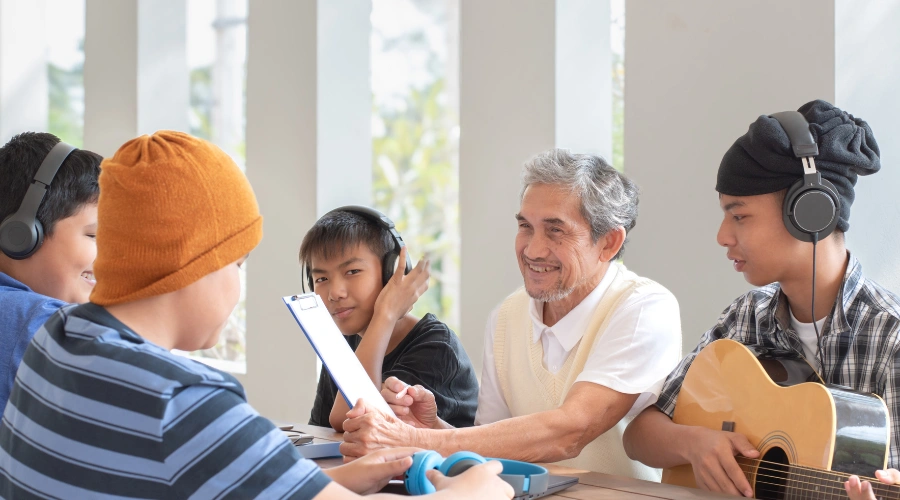
Music therapy sessions are conducted in a group setting at Artemis Adolescent Healing Center. For many teens, we have found that it makes the therapy process less intimidating. It can be difficult for youth to open up in traditional talk therapy, especially when they first start treatment.
In these instances, one of the benefits of music therapy is that it helps teens get more involved in treatment. But how else does it help? What are the other advantages of music therapy for troubled teens, and what happens in a typical music therapy session?
Artemis provides effective mental health care for troubled teens, with adolescent music therapy being among our clients’ favorite offerings. So, with this in mind, let’s talk about the role of music therapy in treatment both at our facility in Tucson and as a general practice.
Find Accredited Teen Treatment Services at Artemis
What are the Benefits of Music Therapy? Understanding the Power of Music Therapy for Troubled Teens
Research shows that music therapy can support mental health in many ways.[1] Potential benefits of music therapy for teens include, but aren’t limited to:
- Self-expression (finding songs that describe how you feel when you can’t, writing or playing music to express yourself).
- A sense of accomplishment and self-efficacy (e.g., feeling and believing that you’re capable).
- Social connection and a sense of belonging.
- Improvements in memory and executive functions.
- Creative development and personal growth.
- Healing trauma and building resilience.
- Relaxation and stress management.
- Self-worth and self-esteem.
- Mood regulation.
- Anxiety relief.
Playing and listening to music can serve as coping skills for difficult emotions. Music therapy sessions are engaging. And at Artemis, we see every day that music therapy is a part of our adolescent treatment programs that many teenagers enjoy.
What Happens During Music Therapy for Teens?

Music therapy for teens can take place in group or individual sessions. This can affect what sessions look like to some degree.
That said, here are some common examples of music therapy activities.
- Songwriting.
- Mindful listening.
- Ensemble-based activities (e.g., learning and playing a song together).
- Playing musical instruments.
- Music improvisation.
- Lyric analysis.
Every therapist and therapy session is different. One week, teens might engage in a mindful or guided listening session, where the therapist directs them to concentrate and reflect on sounds to practice staying in the moment. The next, they might play instruments themselves.
Is Music Therapy Effective for Troubled Teens?
Yes. Claims that music therapy can help teens are not mere assumptions. Research on music therapy has shown that it is helpful for youth navigating a range of different mental, behavioral, and even physical health concerns.[2]
Which Teens Benefit from Music Therapy?
Music therapy can be used as part of a comprehensive treatment program for:
- Trauma and post-traumatic stress disorder (PTSD)
- Physical health problems (e.g., chronic pain) and their emotional effects.
- Behavioral challenges and disruptive behaviors.
- Mood disorders (e.g., depression).
- Substance use disorders.
- Self harm.
- Impulsivity.
- Eating disorders.
- Anxiety.
This is not a complete list. Children and adolescents navigating other concerns can also benefit from music therapy. It’s non-invasive. Music is a great outlet. It’s known to aid emotion regulation.[3] All in all, many find that music therapy interventions are a powerful tool.
Integrating Music Therapy Into Comprehensive Treatment
Music therapy is best used as an add-on to other treatments. Mental health programs that include music therapy often involve weekly group activities that include music therapy sessions, as well as individual therapy, family counseling, and other groups (e.g., dialectical behavior therapy groups).
This is valuable because it means that teens get the benefits of multiple types of treatment. The treatment programs for teens at Artemis incorporate music therapy as part of a comprehensive approach to care for adolescent mental health.
All teens and adolescents at our center get personalized treatment plans. We work closely with clients and their families to help teens build the full set of skills they need to succeed.
Teen Music Therapist Requirements and Credentials

Who will your child work with during music therapy sessions? To become a board-certified music therapist, one must complete:
- Higher education. Music therapists must earn a bachelor’s degree. This is the minimum requirement. Some will have a master’s or doctoral degree.
- Clinical experience. Music therapists must complete at least 1,200 hours of supervised training before they can practice independently. Often, in the form of an internship.
- Board certification. After completing their degree and clinical training requirements, music therapists must pass the national board examination administered by the Certification Board for Music Therapists (CBMT).[4] This allows them to earn the Music Therapist – Board Certified (MT-BC) credential.
Some states have specific requirements. In Arizona, music therapists working with minors must obtain a valid Arizona Department of Public Safety (DPS) Identity Verified Prints (IVP) Fingerprint Clearance Card.
Artemis conducts thorough background checks on all our medical and mental health professionals. We ensure that credentials remain up to date. Parents are welcome to see certifications and degrees.
Many Forms of Insurance Accepted
Call Artemis to Find Effective Therapies That Support Recovery for Your Child
Artemis Adolescent Healing Center is an adolescent-only treatment center in Tucson. We offer a full continuum of care. Whether you’re looking for a residential treatment center for your adolescent or an outpatient program, our JCAHO-accredited facility is a solution.
Programs are available for teens navigating diverse behavioral and mental health challenges. Proud to serve those in our community, we accept most forms of insurance to help people cover treatment costs.
Whether you have a question about music therapy at our center, want to verify your teen’s insurance benefits, or are ready to start the intake process, we can help. Call our confidential, cost-free admissions line today.
References
- The transformative power of music in mental well-being. Psychiatry.org – The Transformative Power of Music in Mental Well-Being. (2023, August 1). https://www.psychiatry.org/news-room/apa-blogs/power-of-music-in-mental-well-being
- Chong, H. J., Kim, H. J., & Kim, B. (2024, September 9). Scoping review on the use of music for emotion regulation. Behavioral sciences (Basel, Switzerland). https://pmc.ncbi.nlm.nih.gov/articles/PMC11428991/
- Effectiveness of music-based therapy on adolescents and children with physical and mental health problems. A systematic review – sciencedirect. (n.d.). https://www.sciencedirect.com/science/article/abs/pii/S0190740925001343
- American Music Therapy Association. FAQ’s | American Music Therapy Association (AMTA). (n.d.). https://www.musictherapy.org/faq/