
Medically Reviewed By

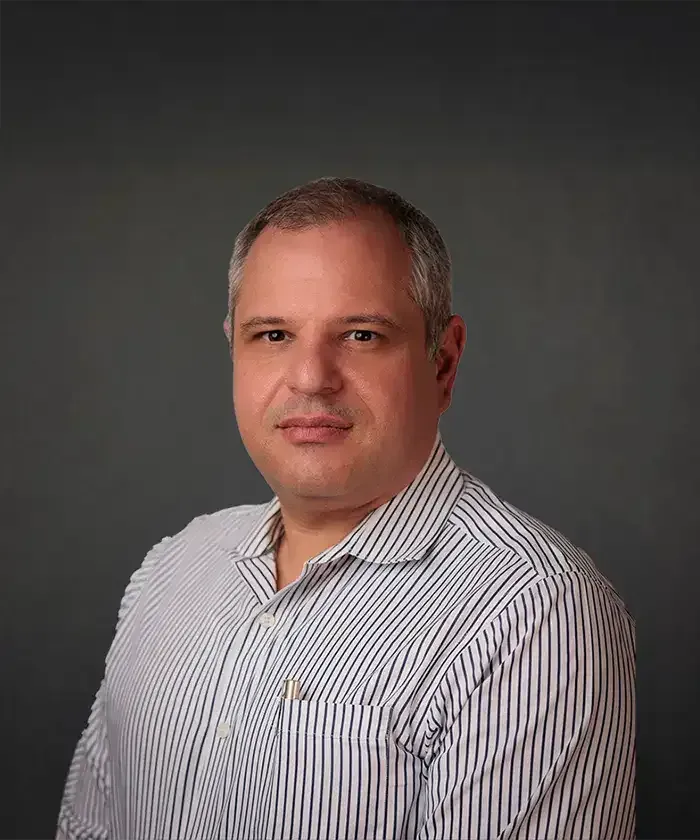
Dr. Roland Segal, a distinguished psychiatrist, holds the role of Medical Director and MD Psychiatrist at Artemis Adolescent Healing Center.
Accreditations & Licensing
 Maiden Voyage LLC · 6599 N Oracle Rd, Suite B, Tucson · PHP and IOP site record
 Maiden Voyage LLC · 16330 N Forecastle Ave, Tucson · Adolescent residential site record
Read our Privacy Policy to learn how information may be used or disclosed and how to contact us about privacy.
Admissions
Accepting Admissions 24/7
Sources and resource links checked October 6, 2026
Let’s be very clear: Do not rely on a pill’s color, shape, imprint, or a friend’s reassurance to decide whether it is safe.
Counterfeit pills can look like prescription medicines and contain fentanyl. Arizona’s Department of Public Safety warns that these pills can be sold through social media and messaging apps as well as on the street (Arizona Department of Public Safety [AZDPS], n.d.).
For a parent, preparation means talking about where pills come from, securing medications at home, learning to use naloxone, and asking how the school responds to a suspected overdose.
You can take these steps without assuming your teen is using drugs.
Act immediately if an overdose may be happening
If someone cannot be awakened, is breathing slowly or struggling to breathe, or has blue or discolored lips or nails, treat it as an emergency.
Gurgling or snoring sounds in someone who cannot be awakened can also signal an overdose.
Call 911 and give naloxone immediately if it is available; do not delay either action while trying to identify the drug.
(Centers for Disease Control and Prevention [CDC], 2024; U.S. Food and Drug Administration [FDA], n.d.-a).
- Give naloxone according to the product’s instructions. Ask another person to call 911 if one is present.
- If the person is not breathing normally, follow the 911 dispatcher’s instructions for rescue breathing or CPR. Do not wait for naloxone to work before supporting breathing.
- When normal breathing returns, place the person on their side if they are not fully awake, and keep monitoring their breathing.
- Stay with them until emergency help arrives, even if they wake up. Tell responders what you know about the substance and naloxone given.
These response steps follow SAMHSA’s federal overdose toolkit. They support emergency response and do not replace hands-on training or the dispatcher’s instructions (Substance Abuse and Mental Health Services Administration [SAMHSA], 2023).
Naloxone’s effect can wear off before the opioid’s effect does. A person may become unresponsive again and need another dose.
Follow the specific product instructions and emergency guidance.
Naloxone treats opioid overdose; it does not replace emergency care for other drugs or medical problems (FDA, n.d.-a).
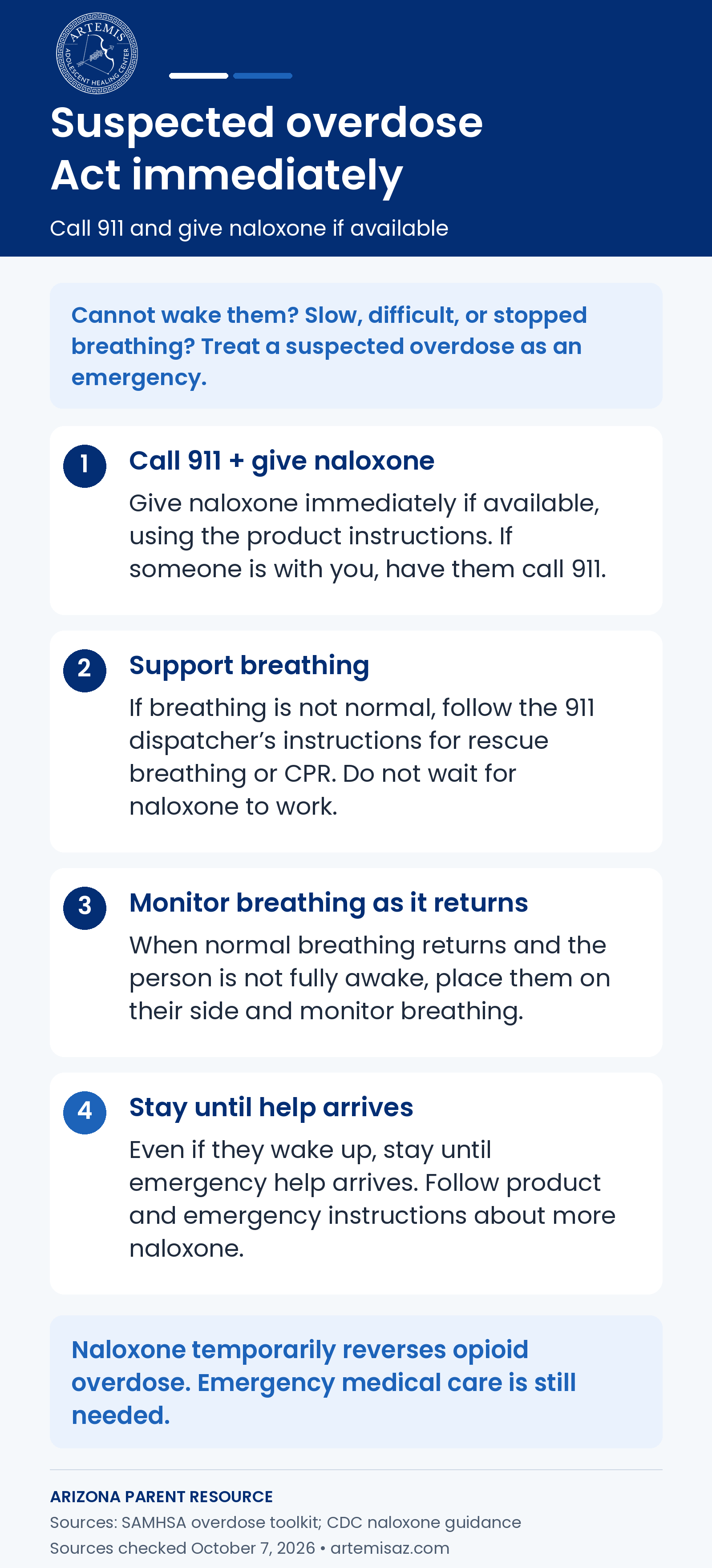
Text version: Suspected overdose – Act immediately
Cannot wake them? Slow, difficult, or stopped breathing? Treat a suspected overdose as an emergency.
- Call 911 + give naloxone: Give naloxone immediately if available, using the product instructions. If someone is with you, have them call 911.
- Support breathing: If breathing is not normal, follow the 911 dispatcher’s instructions for rescue breathing or CPR. Do not wait for naloxone to work.
- Monitor breathing as it returns: When normal breathing returns and the person is not fully awake, place them on their side and monitor breathing.
- Stay until help arrives: Even if they wake up, stay until emergency help arrives. Follow product and emergency instructions about more naloxone.
Again, Naloxone temporarily reverses opioid overdose. Emergency medical care is still needed.
Explain counterfeit pills without guessing about their contents
A counterfeit pill is a fake made to resemble a legitimate prescription medicine. Its appearance can hide different drugs or amounts than someone expects. A familiar imprint or pharmacy-looking bottle does not establish what is inside.
AZDPS says there is no reliable visible warning that a pill contains fentanyl (AZDPS, n.d.).
Make the family rule clear: use medication only as prescribed to the person taking it, and obtain it through a legitimate pharmacy. Sharing a prescription medicine can also cause harm even when the medicine is genuine (Chadi, 2024).
Ask what your teen has heard about pills offered for sleep, anxiety, pain, or studying. Give them time to answer.
You could say, “If someone offers you a pill, I want you to be able to call me. If someone gets sick, get emergency help right away.”
Please remember: these are suggested conversation starters, and not claims that a single conversation prevents an overdose.
Check medication storage at home
Guidance from the American Academy of Pediatrics recommends storing controlled medications in a locked cabinet and keeping the key or combination secure. Ask your teen’s prescriber or pharmacist how to manage their own medicine safely, including any doses taken at school. Keep following the prescription; concerns about misuse should lead to a conversation with the clinician (Chadi, 2024).
Review unused and expired medicines. FDA recommends a take-back option for most medicines; when one is not readily available, the right disposal method depends on the medicine.
Ask a pharmacist or use FDA’s disposal guidance rather than flushing every medicine or putting every product in household trash (FDA, n.d.-b).
Include medicines kept by other household members. Write down who will arrange secure storage, check supplies, and handle disposal. Keep emergency naloxone somewhere people can reach promptly, while following its storage instructions.
Get naloxone and learn how to use it
Naloxone is a medicine that can temporarily reverse an opioid overdose, including one involving fentanyl. CDC says it can be given to people of all ages. SAMHSA advises using it for suspected overdose even when you are unsure what drugs were taken.
Training can help you recognize an overdose and act while emergency help is on the way (CDC, 2024; SAMHSA, 2023).
Ask a pharmacist which naloxone product is available, how to use it, how many devices to keep, and how to store it. Some nasal-spray products are sold over the counter; other forms may have different access requirements.
Ask about price instead of assuming insurance or a standing order makes it free (FDA, n.d.-a).
| Area | Verified public resource | What to confirm |
|---|---|---|
| Tucson and Pima County | Pima County naloxone resources Information on pharmacy access, free distribution, and training. | Which distribution site is open, what product is available, whether it is free, and where training is offered. |
| Phoenix | City of Phoenix overdose reversal kits The city lists free kits at public libraries and other city sites. | Current pickup location, hours, stock, and instructions included with the kit. |
| Other Arizona communities | Sonoran Prevention Works supplies Outreach locations and a naloxone-by-mail application. | The mail program is described for residents outside areas served by its outreach sites. Check your address and current access route. |
Sources: Pima County (n.d.), City of Phoenix (n.d.), and Sonoran Prevention Works (n.d.). Listings were checked on public websites on October 6, 2026. If a site has no kits, ask about another location or a pharmacy. Do not wait for a supply order during an emergency.
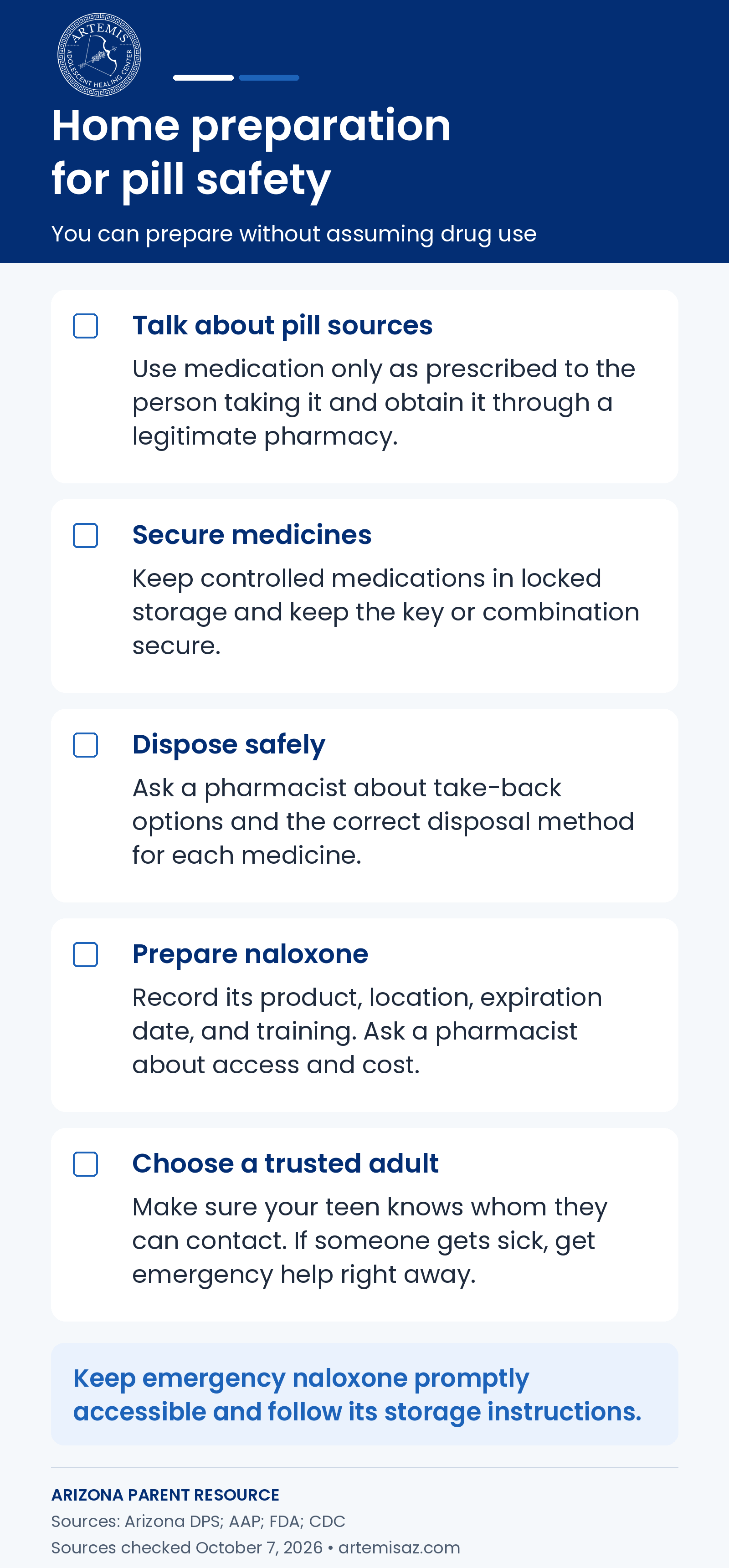
Text version: Home preparation for pill safety
- Talk about pill sources: Use medication only as prescribed to the person taking it and obtain it through a legitimate pharmacy.
- Secure medicines: Keep controlled medications in locked storage and keep the key or combination secure.
- Dispose safely: Ask a pharmacist about take-back options and the correct disposal method for each medicine.
- Prepare naloxone: Record its product, location, expiration date, and training. Ask a pharmacist about access and cost.
- Choose a trusted adult: Make sure your teen knows whom they can contact. If someone gets sick, get emergency help right away.
Keep emergency naloxone promptly accessible and follow its storage instructions.
Ask the school about its overdose plan
Arizona’s Department of Education developed the STOP-IT school toolkit to support overdose preparation and response.
Its public page now says the task force has concluded and the toolkit remains available. A toolkit or a distribution announcement does not establish how an individual school has implemented its response (Arizona Department of Education [ADE], n.d.).
For details specific to your child’s school in Arizona, ask the school nurse or administrator how its current plan works during classes, sports, field trips, and after-school activities.
Useful questions include:
- Who is trained to recognize an overdose and give naloxone?
- Where is naloxone stored, and can trained staff reach it quickly?
- Who checks expiration dates and replaces used supplies?
- Who calls 911 and stays with the student?
- How is the caregiver notified, and who coordinates support afterward?
You do not need a student’s private treatment details to ask how the school prepares for emergencies. If your teen takes a prescribed medication during the day, separately ask about the school’s dispensing and storage process.
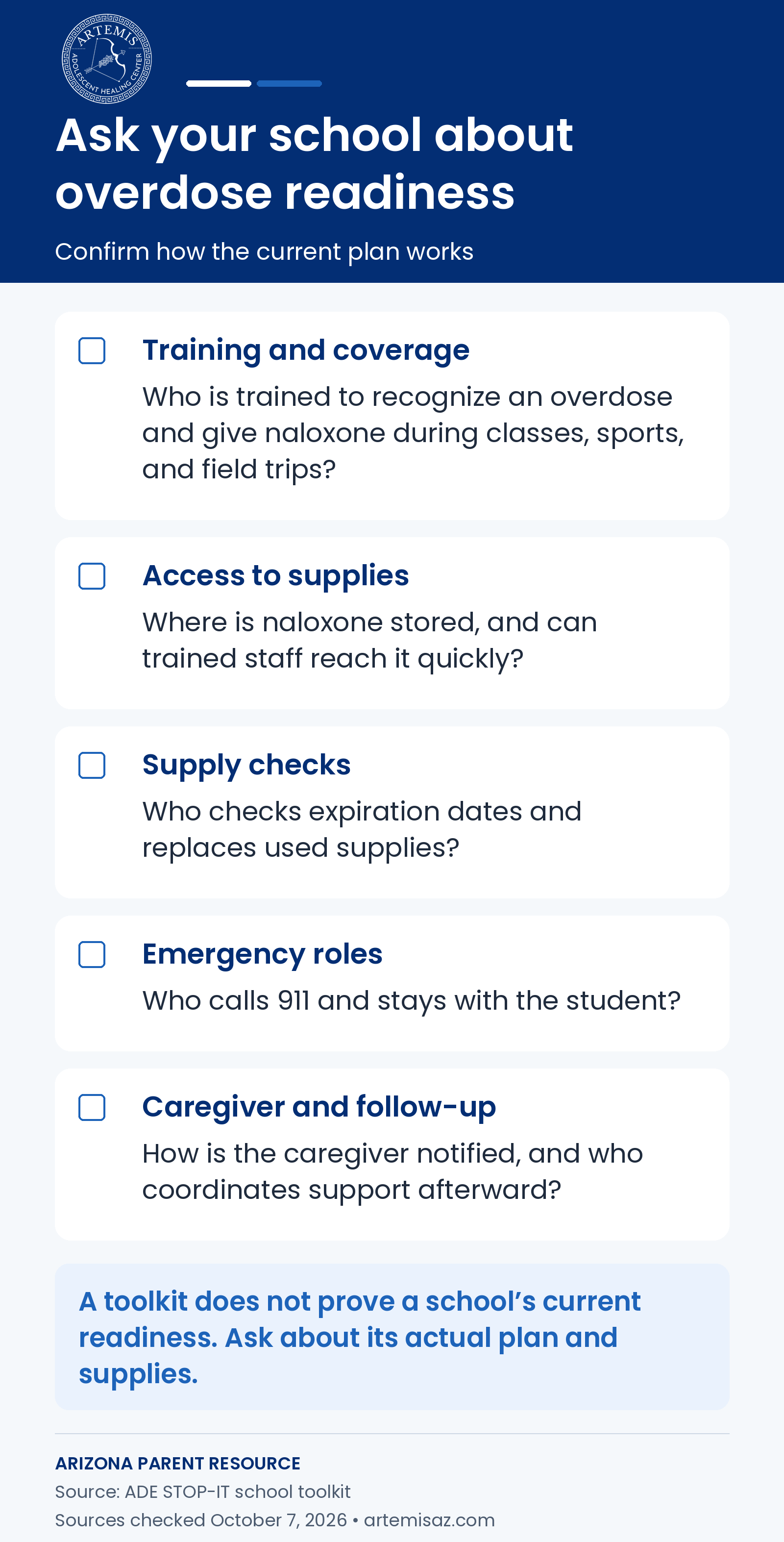
Text version: Ask your school about overdose readiness
- Training and coverage: Who is trained to recognize an overdose and give naloxone during classes, sports, and field trips?
- Access to supplies: Where is naloxone stored, and can trained staff reach it quickly?
- Supply checks: Who checks expiration dates and replaces used supplies?
- Emergency roles: Who calls 911 and stays with the student?
- Caregiver and follow-up: How is the caregiver notified, and who coordinates support afterward?
Again, a toolkit does not prove a school’s current readiness. Ask about its actual plan and supplies for your child’s specific school.
Use a home and school preparation record
| Task | Family or school follow-through |
|---|---|
| Talk about pill sources | Choose a calm time, ask what your teen has heard, and identify a trusted adult they can contact. |
| Secure medicines | Name the adult responsible for locked storage and safe disposal. |
| Prepare naloxone | Record the product, location, expiration date, training completed, and person who checks it. |
| Check the school response | Record the school contact and any unanswered questions about response and supplies. |
| Plan after an emergency | Ask the treating team about a follow-up assessment, medication questions, naloxone replacement, and ongoing care. |
This record supports planning and discussion. The treating clinician should guide care after a suspected overdose. Tell that clinician about both substance exposure and mental health concerns so the assessment can address the whole situation.
Ask about ongoing teen treatment
At Artemis Adolescent Healing Center, we offer treatment for teen pill use and related mental health needs.
Our team can discuss treatment options at (520) 614-8647 after emergency needs are addressed.
Ask the medical team about any withdrawal-management or medical-clearance needs before arranging ongoing treatment at our programs.
References
Arizona Department of Education. (n.d.). StopIt. Retrieved October 6, 2026, from https://www.azed.gov/wellness/school-nursing-and-health-services/stopit
Arizona Department of Public Safety. (n.d.). Fentanyl awareness. Retrieved October 6, 2026, from https://www.azdps.gov/fentanyl
Centers for Disease Control and Prevention. (2024, May 2). 5 things to know about naloxone. https://www.cdc.gov/overdose-prevention/reversing-overdose/about-naloxone.html
Chadi, N. (2024, November 18). Dangers of prescription drug misuse: Tips to keep your teen safe. HealthyChildren.org. https://www.healthychildren.org/English/ages-stages/teen/substance-abuse/Pages/dangers-of-prescription-drug-misuse-tips-to-keep-your-teen-safe.aspx
City of Phoenix. (n.d.). Naloxone opioid overdose reversal kits. Retrieved October 6, 2026, from https://www.phoenix.gov/administration/departments/health/substance-use-help/narcan-kits.html
Pima County. (n.d.). Naloxone. Retrieved October 6, 2026, from https://www.pima.gov/naloxone
Sonoran Prevention Works. (n.d.). Get supplies. Retrieved October 6, 2026, from https://spwaz.org/get-supplies/
Substance Abuse and Mental Health Services Administration. (2023). SAMHSA overdose prevention and response toolkit (Publication No. PEP23-03-00-001). https://www.cdc.gov/overdose-prevention/media/pdfs/2024/04/SAMHSA-overdose-prevention-response-toolkit.pdf
U.S. Food and Drug Administration. (n.d.-a). Access to naloxone can save a life during an opioid overdose. Retrieved October 6, 2026, from https://www.fda.gov/consumers/consumer-updates/access-naloxone-can-save-life-during-opioid-overdose
U.S. Food and Drug Administration. (n.d.-b). Drug disposal: Questions and answers. Retrieved October 6, 2026, from https://www.fda.gov/drugs/disposal-unused-medicines-what-you-should-know/drug-disposal-questions-and-answers