
Medically Reviewed By

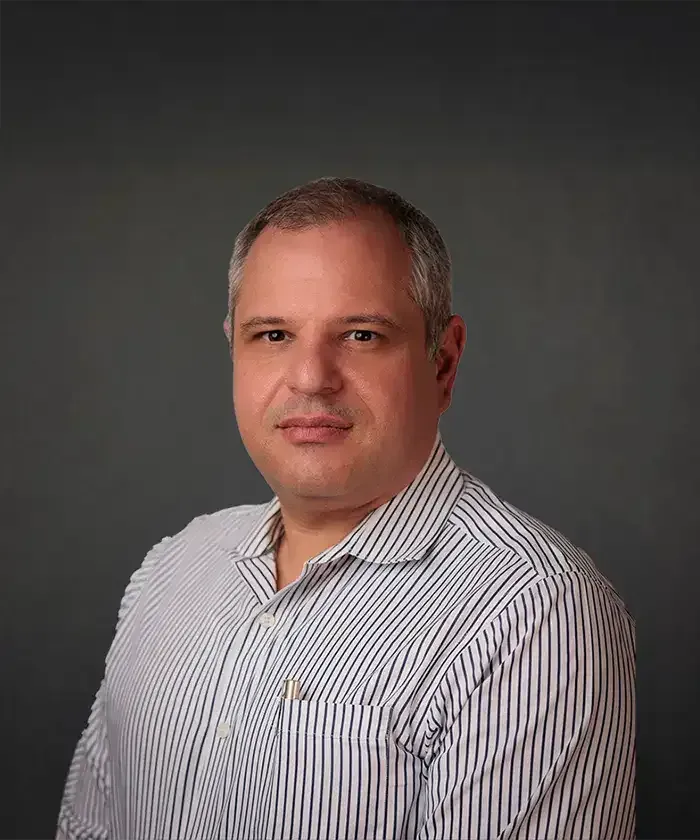
Dr. Roland Segal, a distinguished psychiatrist, holds the role of Medical Director and MD Psychiatrist at Artemis Adolescent Healing Center.
Accreditations & Licensing
 Maiden Voyage LLC · 6599 N Oracle Rd, Suite B, Tucson · PHP and IOP site record
 Maiden Voyage LLC · 16330 N Forecastle Ave, Tucson · Adolescent residential site record
Read our Privacy Policy to learn how information may be used or disclosed and how to contact us about privacy.
Admissions
Accepting Admissions 24/7
Sources and resource links checked October 6, 2026
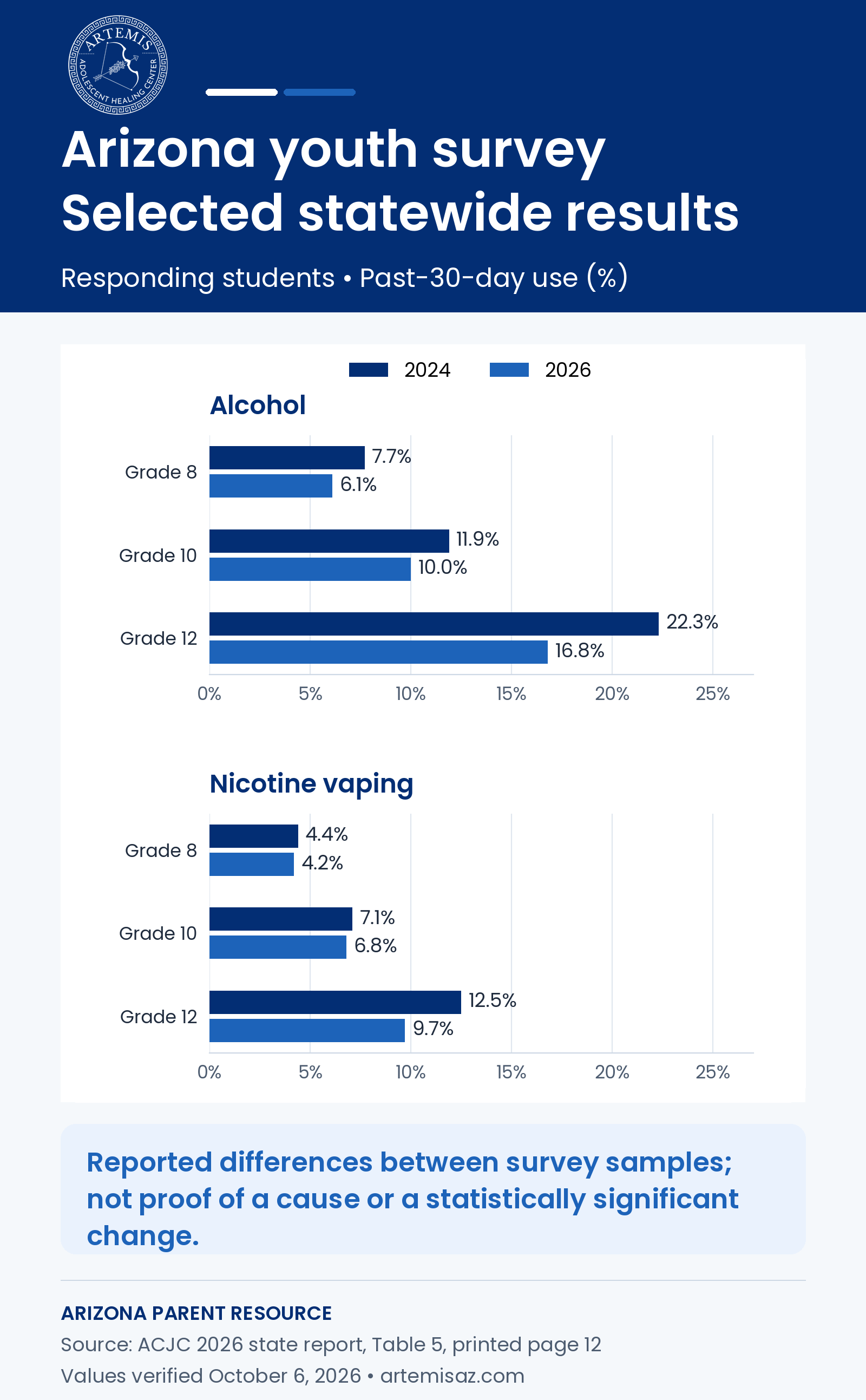
Arizona’s 2026 Youth Survey reports lower past-30-day alcohol and nicotine-vaping use than in 2024 in each of the statewide eighth-, tenth-, and twelfth-grade samples. (Arizona Criminal Justice Commission [ACJC], 2026c, Table 5)
While this is encouraging context for prevention, your teen’s need for help depends on their own experience.
For Tucson and Phoenix families, county reports add useful detail. They also show why a statewide headline cannot describe every local grade group.
Please read the measure, grade, year, and sample before drawing a conclusion.
Know who answered the survey
The main report includes 41,235 students from 264 schools, in grades 8, 10, and 12. It is based on student reports, not a census, toxicology testing, or clinical diagnoses. The seventh-grade supplemental survey is separate.
Participation was voluntary, and absent or nonparticipating students are not represented (ACJC, 2026c, pp. ii–3).
Use the official survey page to open the state and county reports. County reports begin with an executive summary of statewide data.
For a county finding, check the county’s own tables rather than attributing that opening summary to local students.
Keep lifetime use separate from recent use
“Lifetime use” means a student reported trying a substance at least once.
“Past-30-day use” means at least one use during that period.
These yes-or-no summaries do not establish frequency, amount, or a substance use disorder.
For alcohol, the question specifies more than a few sips (ACJC, 2026c, Tables 3 and 5).
These distinctions change the conversation. A past experience, repeated current use, and a suspected overdose each call for different questions and responses. At Artemis, we like to be sure to tell parents: a survey percentage cannot make those decisions for a family.
Selected statewide results by grade
The table shows the percentage of responding students reporting use in the past 30 days.
Nicotine vaping refers to e-liquid or e-juice with nicotine; it does not measure every kind of vaping.
| Measure | Grade | 2024 | 2026 |
|---|---|---|---|
| Alcohol | 8 | 7.7% | 6.1% |
| Alcohol | 10 | 11.9% | 10.0% |
| Alcohol | 12 | 22.3% | 16.8% |
| Nicotine vaping | 8 | 4.4% | 4.2% |
| Nicotine vaping | 10 | 7.1% | 6.8% |
| Nicotine vaping | 12 | 12.5% | 9.7% |
Source: ACJC (2026c), State Report, Table 5, printed page 12. These are reported differences between survey samples, not proof of a cause or a statistically significant change.
For example, the twelfth-grade alcohol figure fell by 5.5 percentage points, from 22.3% to 16.8%.
“Percentage points” describes the gap between two percentages. It is different from saying use fell by 5.5 percent.
Looking more closely at Pima and Maricopa findings
Selected county results illustrate a more varied local picture.
The same past-30-day questions are shown below.
Each row describes respondents in that county and grade; it does not describe every student there.
| County and grade | Alcohol 2024 to 2026 | Nicotine vaping 2024 to 2026 |
|---|---|---|
| Pima grade 8 | 7.3% to 8.0% | 4.3% to 6.3% |
| Pima grade 12 | 17.2% to 17.2% | 9.3% to 7.6% |
| Maricopa grade 10 | 10.8% to 9.5% | 5.9% to 6.2% |
| Maricopa grade 12 | 22.2% to 16.9% | 11.5% to 9.2% |
Sources: ACJC (2026a, 2026b), Maricopa and Pima Reports, Table 5, printed page 12. Pima’s eighth-grade nicotine-vaping figure was higher in 2026, while Maricopa’s tenth-grade figure was slightly higher. These samples do not support a blanket statement that every local group reported less use.
Participation also differed. Pima had 4,445 respondents, about 12% of enrolled students in the three surveyed grades; Maricopa had 27,287, about 15%.
Their grade mix was different, so a combined county percentage can be misleading as a comparison (ACJC, 2026a, 2026b, Tables 1 and 2).
These limits make the reports useful starting points for school discussions rather than county rankings.
Ask whether your teen’s school participated and how staff use its results to plan prevention and support. Avoid treating a county’s result as a prediction about your child.
Watch for changes in the questions
In 2026, “marijuana” became “marijuana or marijuana products,” and nicotine-pouch questions were added. A new item has no earlier baseline.
Even when a table shows multiple years, check its notes before calling the result a like-for-like trend (ACJC, 2026b, Section 2.1 and Appendix C).
Ask what a teen means by “vaping” or “a gummy” instead of assuming a product. The survey treats nicotine e-cigarettes, marijuana concentrates, and edibles as separate measures. Those categories should stay distinct in an appointment or a school conversation.
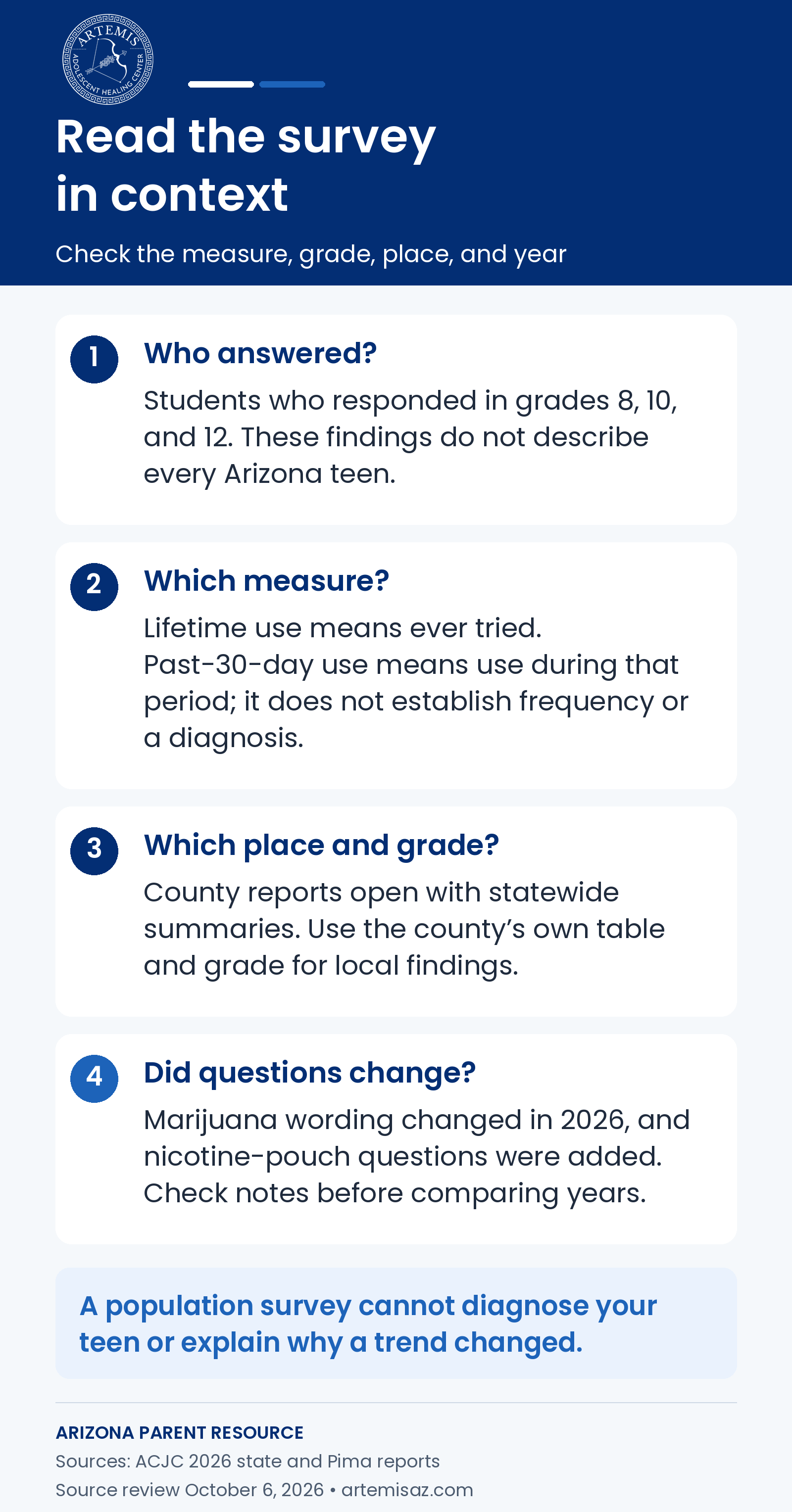
Text version: Reading the 2026 Arizona Youth Survey in context
- Who answered?: Students who responded in grades 8, 10, and 12. These findings do not describe every Arizona teen.
- Which measure?: Lifetime use means ever tried. Past-30-day use means use during that period; it does not establish frequency or a diagnosis.
- Which place and grade?: County reports open with statewide summaries. Use the county’s own table and grade for local findings.
- Did questions change?: Marijuana wording changed in 2026, and nicotine-pouch questions were added. Check notes before comparing years.
Use the evidence to start a useful conversation
The CDC encourages parents to discuss mental health and substance use openly and without judgment.
News can provide an opening, but the conversation should give your teen room to explain their experience (CDC, 2026b).
Try one question and listen before moving to the next.
| What you want to understand | A question you can adapt |
|---|---|
| Peer pressure | What happens when someone in your group does not want to drink or vape? |
| Product uncertainty | What do people mean when they say they are vaping? Do they always know what is in it? |
| Coping | When school or life feels difficult, what helps you get through it? |
| Getting support | Which adult would you feel comfortable talking with if you or a friend needed help? |
| A next step | Would it help to talk with your doctor or someone at school? What would make that easier? |
These prompts are an original discussion tool, not survey questions or a clinical screen. You can note an unanswered question and return to it later.
Please do not use statewide figures to accuse your teen or dismiss something they have told you.
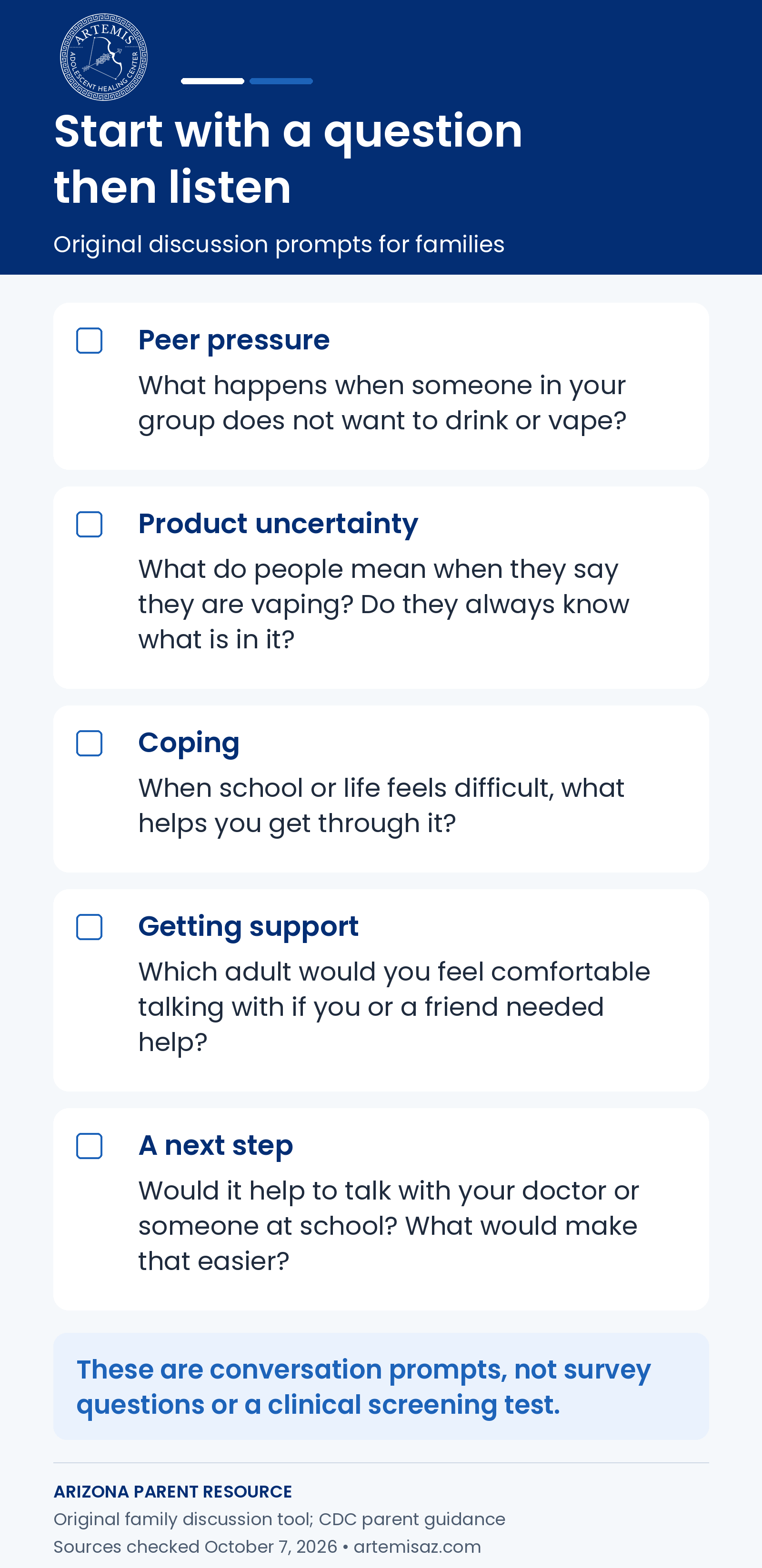
Text version: Start with a question then listen to your teen
- Peer pressure: What happens when someone in your group does not want to drink or vape?
- Product uncertainty: What do people mean when they say they are vaping? Do they always know what is in it?
- Coping: When school or life feels difficult, what helps you get through it?
- Getting support: Which adult would you feel comfortable talking with if you or a friend needed help?
- A next step: Would it help to talk with your doctor or someone at school? What would make that easier?
These are conversation prompts, not survey questions or a clinical screening test.
Seek an assessment when there is a concern
If you are worried about current use, tell a clinician what you have observed: the substance or product, timing, any medication use, and changes in sleep, school, or relationships.
Changes in behavior alone do not identify drug use or its cause. Be clear and transparent when the contents or amount are unknown. Include the reason your teen gives for using, such as trying to cope with distress.
The CDC describes substance use and mental health concerns as issues that can occur together.
A clinician can assess both; the survey does not diagnose either one in an individual (CDC, 2026a).
If your teen is in immediate danger, has a serious injury, cannot be awakened, has trouble breathing, or may have overdosed, call 911. For suicidal crisis or emotional distress, call 988 or text 988 for the 988 Suicide & Crisis Lifeline. Do not wait for a routine appointment during an emergency.
At Artemis Adolescent Healing Center, we provide treatment for teen substance use and mental health concerns. Contact our team at (520) 614-8647 to discuss your teen’s needs and treatment options. Bring your observations and questions; a statewide trend cannot replace an individual assessment.
References
988 Suicide & Crisis Lifeline. (n.d.). Help someone else. Retrieved October 6, 2026, from https://988lifeline.org/help-someone-else/
Arizona Criminal Justice Commission. (2026a). 2026 Arizona Youth Survey: Maricopa County report. https://www.azcjc.gov/Portals/0/Documents/pubs/AYSReports/2026/2026_AYS_Maricopa_Report.pdf
Arizona Criminal Justice Commission. (2026b). 2026 Arizona Youth Survey: Pima County report. https://www.azcjc.gov/Portals/0/Documents/pubs/AYSReports/2026/2026_AYS_Pima_Report.pdf
Arizona Criminal Justice Commission. (2026c). 2026 Arizona Youth Survey: State report. https://www.azcjc.gov/Portals/0/Documents/pubs/AYSReports/2026/2026_AYS_State_Report.pdf
Centers for Disease Control and Prevention. (2026a, March 27). Free Mind for parents and caregivers. https://www.cdc.gov/free-mind/parents/index.html
Centers for Disease Control and Prevention. (2026b, March 27). Talk to your teen. https://www.cdc.gov/free-mind/parents/talk-to-your-teen.html
Substance Abuse and Mental Health Services Administration. (2023). SAMHSA overdose prevention and response toolkit (Publication No. PEP23-03-00-001). https://www.cdc.gov/overdose-prevention/media/pdfs/2024/04/SAMHSA-overdose-prevention-response-toolkit.pdf