

Medically Reviewed By

Dr. Roland Segal, a distinguished psychiatrist, holds the role of Medical Director and MD Psychiatrist at Artemis Adolescent Healing Center.
Accreditations & Licensing
 Maiden Voyage LLC · 6599 N Oracle Rd, Suite B, Tucson · PHP and IOP site record
 Maiden Voyage LLC · 16330 N Forecastle Ave, Tucson · Adolescent residential site record
Read our Privacy Policy to learn how information may be used or disclosed and how to contact us about privacy.
Admissions
Accepting Admissions 24/7
Sources and resource links checked October 6, 2026
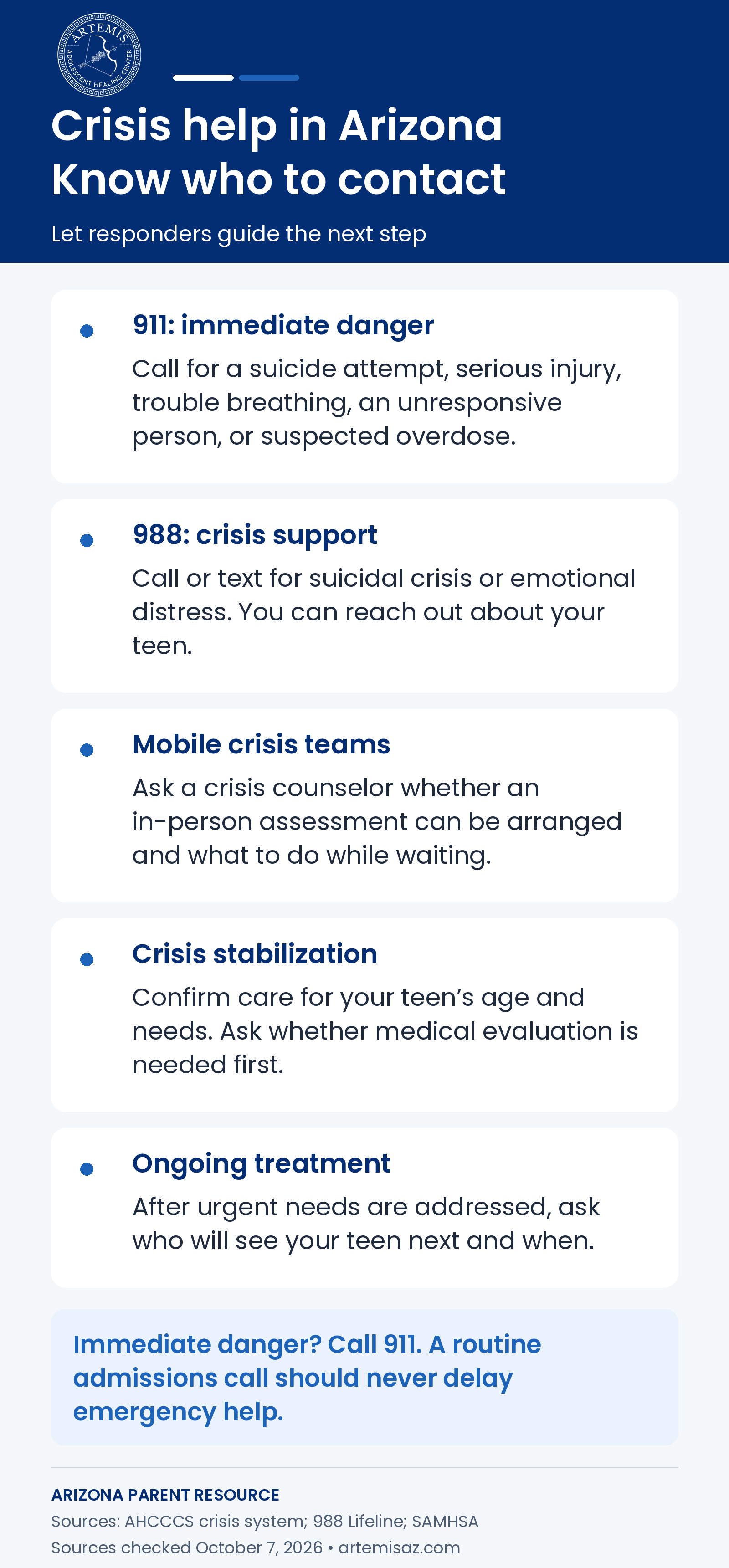
If your teen is in immediate danger, has attempted suicide, is seriously injured, cannot be awakened, has trouble breathing, or may have overdosed, call 911.
For suicidal crisis or emotional distress, call 988 or text 988 for the 988 Suicide & Crisis Lifeline. You can contact 988 about someone else, including your child (988 Suicide & Crisis Lifeline, n.d.; Substance Abuse and Mental Health Services Administration [SAMHSA], 2023).
Arizona families can also access mobile crisis teams and crisis stabilization services. The next step depends on your teen’s immediate safety and clinical needs.
Ask a crisis counselor or emergency professional to help you navigate care; you do not have to choose a treatment level on your own (Arizona Health Care Cost Containment System [AHCCCS], n.d.).
Tell the responder what is happening now
Start with your teen’s age, current location, and what prompted the call. Describe what they said or did, any injury or possible substance exposure, and whether you can stay with them safely.
Be direct about suicidal thoughts. Avoid promising to keep a threat of self-harm secret (988 Suicide & Crisis Lifeline, n.d.).
You might say: “My teen is 15, and we are at home in Tucson. They said they might hurt themselves. I need help with what to do now.”
This is sample wording, not a screening test. Tell the responder if you cannot safely remain nearby or if anyone else is at risk.
If it is safe to do so, stay with your teen while help is arranged. Ask the responder how to reduce access to medications, firearms, or other dangerous items. Do not attempt to take an item away if that could put someone in danger.
For later consideration, NIMH’s youth assessment guidance includes discussing dangerous items and whether caregivers can keep a child safe at home (National Institute of Mental Health [NIMH], n.d.).
Understand the different kinds of help
AHCCCS describes Arizona’s crisis system as including telephone support, mobile teams, and facilities for crisis stabilization. These services have different jobs.
A telephone conversation can help identify a next step; a mobile team can assess someone in person; a facility can provide observation and stabilization. A medical emergency requires emergency medical care (AHCCCS, n.d.).
| Resource | Purpose | Question to ask |
|---|---|---|
| 911 and emergency medical care | Respond to immediate danger, serious injury, breathing problems, or suspected overdose. | Give the exact location and current symptoms; follow the dispatcher’s instructions. |
| 988 Lifeline | Crisis counseling and connection with resources for suicidal crisis or emotional distress. | What should we do now, and what local help is appropriate for a minor? |
| Mobile crisis response | An in-person behavioral health assessment when a response can be arranged. | Is a team appropriate here? What should we do while waiting? |
| Crisis stabilization | Short-term assessment, observation, and treatment at a crisis facility. | Can this site serve my teen’s age and needs? Is medical evaluation needed first? |
| Ongoing treatment | Care after the immediate crisis, based on an assessment. | Who will see our teen next, and when is the appointment? |
This comparison is a navigation aid. It does not determine whether your teen can safely wait, travel by car, or return home. Ask the responding professional about those decisions. Again, if danger becomes immediate, call 911.
Local resources for Pima and Maricopa families
The following providers publicly describe youth services.
Listings were checked on October 6, 2026; there was no telephone confirmation of intake rules, staffing, or available space. Use the linked provider pages for current details and discuss safe transport with a crisis professional.
| Area and provider | Published youth access | Details to confirm |
|---|---|---|
| Tucson and Pima County Connections Tucson Crisis Response Center 2802 East District Street, Tucson (520) 301-2400 | The provider lists youth and adult crisis services and 24-hour operation. Its location page does not give a precise youth age range. | Ask about your teen’s exact age, current intake, medical-clearance needs, guardian requirements, and the appropriate entrance. |
| Phoenix and Maricopa County MIND 24-7 Phoenix North-Central 10046 N Metro Pkwy W, Phoenix 1-844-646-3247 | The provider lists 24-hour walk-in care for children and teens. Its FAQ describes care for children of all ages and parent or guardian involvement for minors. | Confirm care for your teen’s age and symptoms, consent arrangements, payment questions, and whether medical care is needed first. |
Sources: Connections Health Solutions (n.d.); MIND 24-7 (n.d.-a, n.d.-b). A published listing cannot establish whether a particular teen can be treated there today. If a site cannot meet your teen’s needs, ask the crisis counselor or clinical team to identify an appropriate alternative.
Ask about insurance without delaying urgent help
AHCCCS says Arizona’s crisis services are available to residents regardless of insurance coverage.
Seek urgent help when it is needed. Coverage and charges for an ambulance, emergency department, inpatient stay, or later treatment may differ; ask the relevant organization to explain them (AHCCCS, n.d.).
For a clinic visit, ask whether the service will be funded through insurance, a crisis program, or self-pay. MIND 24-7 describes financial options for uninsured patients; that does not establish free care for every visit (MIND 24-7, n.d.-b).
Ask whom to contact if you receive a bill you do not understand.
Have useful information ready
- Your teen’s age, location, and safe callback number.
- What happened today, including statements about self-harm or possible ingestion.
- Current medications, allergies, and known medical conditions, if available.
- Recent treatment and the names of current clinicians.
- Parent or guardian contact information and any interpreter or communication needs.
Gather this information only if doing so will not delay emergency help.
Tell the clinician when something is unknown. Accurate uncertainty is more useful than a guess.
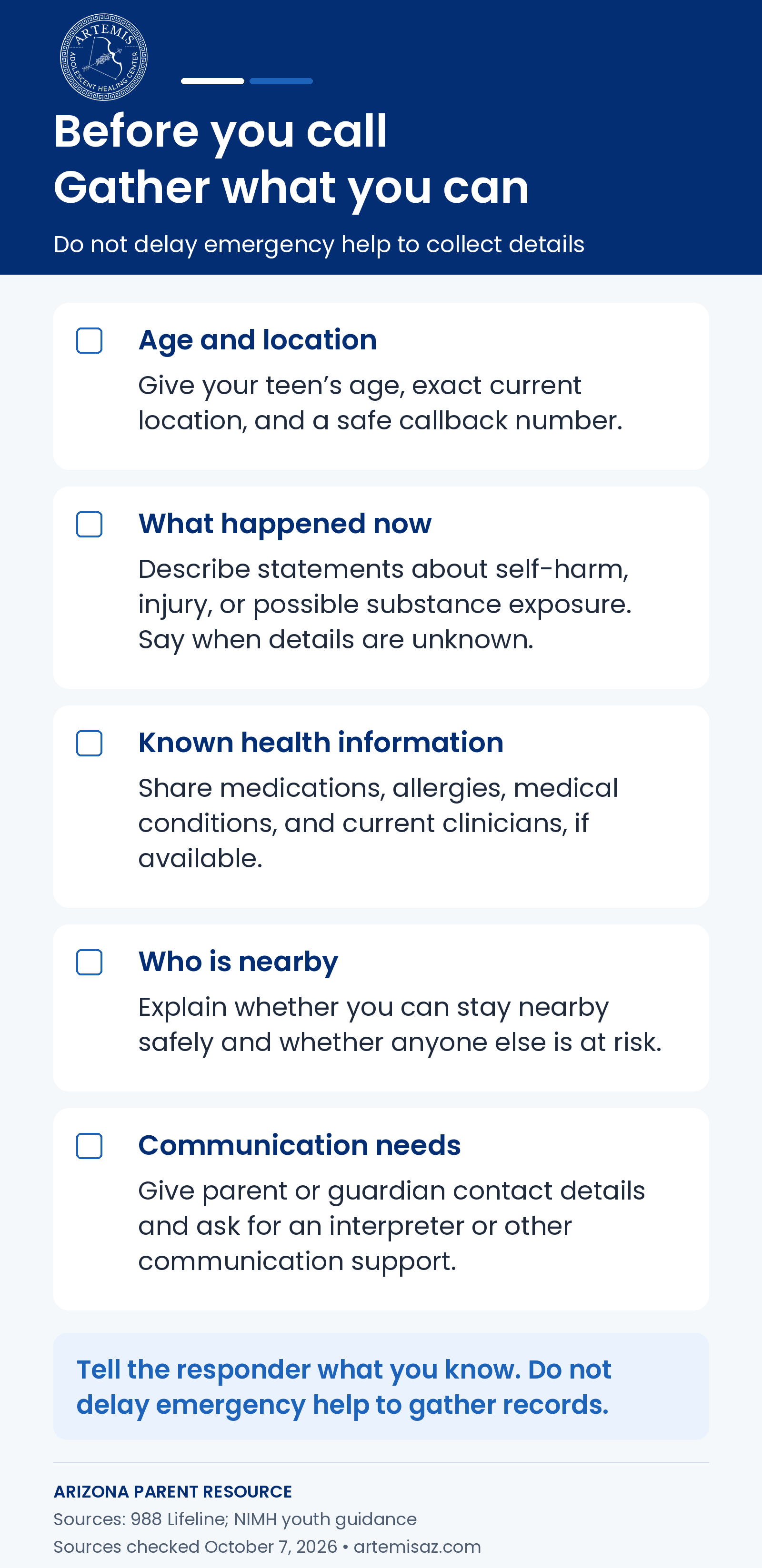
Text version: Before you call Gather what you can
- Age and location: Give your teen’s age, exact current location, and a safe callback number.
- What happened now: Describe statements about self-harm, injury, or possible substance exposure. Say when details are unknown.
- Known health information: Share medications, allergies, medical conditions, and current clinicians, if available.
- Who is nearby: Explain whether you can stay nearby safely and whether anyone else is at risk.
- Communication needs: Give parent or guardian contact details and ask for an interpreter or other communication support.
Tell the responder what you know. Do not delay emergency help to gather records.
Leave with a clear follow-up plan
Before discharge, ask the treating team to review the plan with you and your teen. NIMH’s clinical guidance includes safety planning, discussion of dangerous items, and follow-up care when indicated.
Those decisions require clinical assessment; a promise to stay safe is not a substitute for it (NIMH, n.d.).
- What changes or warning signs mean we should seek help again?
- What safety steps should we take at home, and who is responsible for them?
- Which medications are prescribed now, and whom do we call with questions?
- Who will provide the next appointment, and is it actually scheduled?
- What should we do if the receiving provider cannot see our teen?
Write down the receiving provider, appointment date, and contact person. Ask how records will be transferred and whether you need to sign a release.
If school attendance is affected, discuss what the school needs to know and who can coordinate that conversation. Share only the information needed for support.
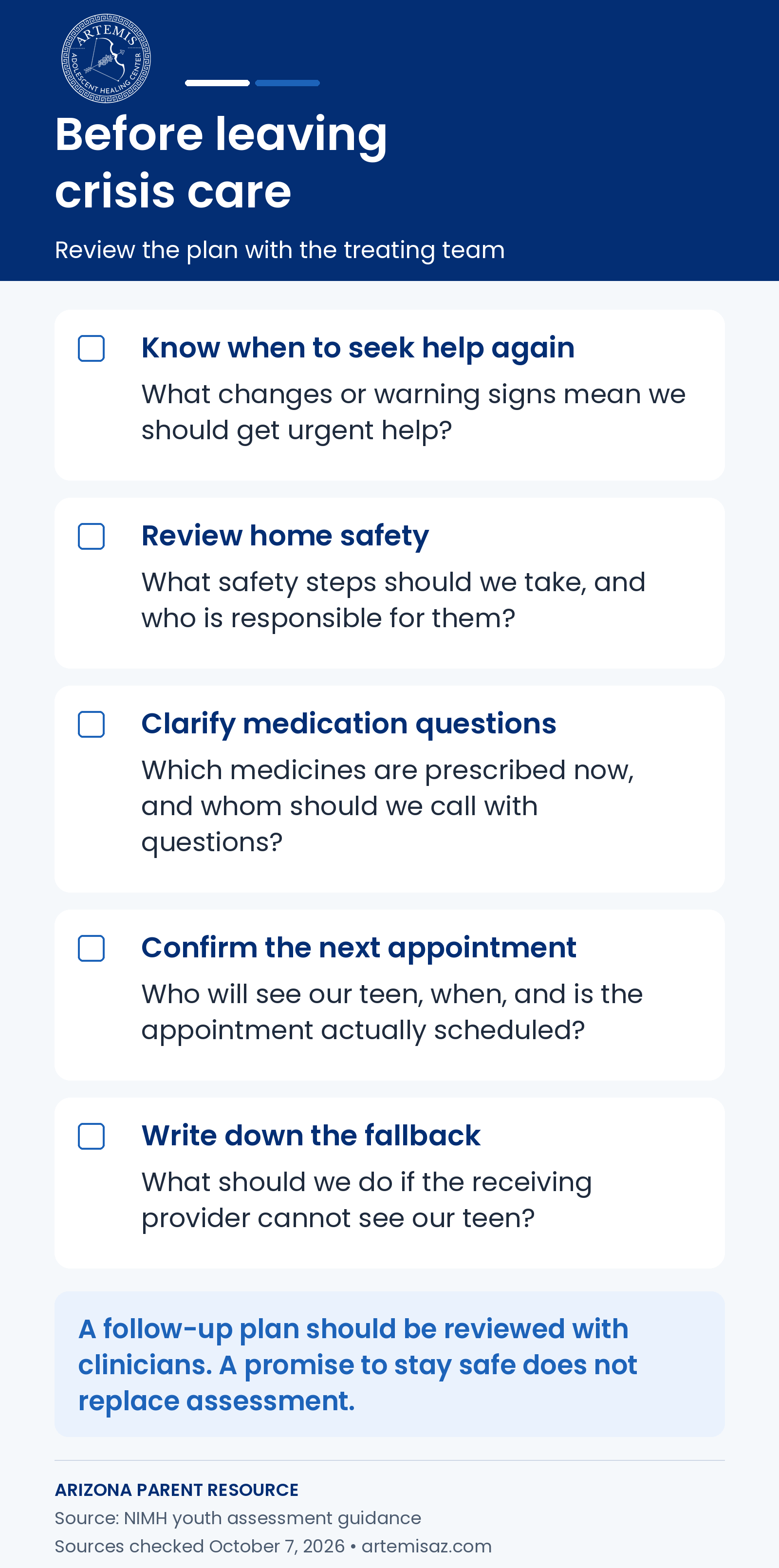
Text version: Before leaving crisis care
- Know when to seek help again: What changes or warning signs mean we should get urgent help?
- Review home safety: What safety steps should we take, and who is responsible for them?
- Clarify medication questions: Which medicines are prescribed now, and whom should we call with questions?
- Confirm the next appointment: Who will see our teen, when, and is the appointment actually scheduled?
- Write down the fallback: What should we do if the receiving provider cannot see our teen?
A follow-up plan should be reviewed with clinicians. A promise to stay safe does not replace assessment.
Discuss treatment after the immediate crisis
At Artemis Adolescent Healing Center, we provide mental health treatment for teens ages 12–17.
After urgent safety needs have been addressed, our team can discuss your teen’s needs, including treatment for suicidal ideation, and care options at (520) 614-8647.
We have to be clear once again here: use 911 or 988 for immediate emergency or crisis help; an admissions inquiry should not delay that response or come before emergency services are called.
References
988 Suicide & Crisis Lifeline. (n.d.). Help someone else. Retrieved October 6, 2026, from https://988lifeline.org/help-someone-else/
Arizona Health Care Cost Containment System. (n.d.). Arizona’s crisis system. Retrieved October 6, 2026, from https://azahcccs.gov/BehavioralHealth/ArizonaCrisisSystem.html
Connections Health Solutions. (n.d.). Connections Tucson. Retrieved October 6, 2026, from https://connectionshs.com/tucson
MIND 24-7. (n.d.-a). 24 hour urgent mental health care clinic in Phoenix. Retrieved October 6, 2026, from https://www.mind24-7.com/locations/location-az-phoenix-north-central/
MIND 24-7. (n.d.-b). FAQs. Retrieved October 6, 2026, from https://www.mind24-7.com/patients-families/faqs/
National Institute of Mental Health. (n.d.). Youth emergency department brief suicide safety assessment guide. Retrieved October 6, 2026, from https://www.nimh.nih.gov/research/research-conducted-at-nimh/asq-toolkit-materials/youth-ed/youth-emergency-department-brief-suicide-safety-assessment-guide
Substance Abuse and Mental Health Services Administration. (2023). SAMHSA overdose prevention and response toolkit (Publication No. PEP23-03-00-001). https://www.cdc.gov/overdose-prevention/media/pdfs/2024/04/SAMHSA-overdose-prevention-response-toolkit.pdf