

Medically Reviewed By

Dr. Roland Segal, a distinguished psychiatrist, holds the role of Medical Director and MD Psychiatrist at Artemis Adolescent Healing Center.
Accreditations & Licensing
 Maiden Voyage LLC · 6599 N Oracle Rd, Suite B, Tucson · PHP and IOP site record
 Maiden Voyage LLC · 16330 N Forecastle Ave, Tucson · Adolescent residential site record
Read our Privacy Policy to learn how information may be used or disclosed and how to contact us about privacy.
Admissions
Accepting Admissions 24/7
Sources and resource links checked October 6, 2026
Start by asking your teen’s school counselor, social worker, nurse, or principal how to request a mental health referral. Your teen does not need an individualized education program, or IEP, to receive behavioral health services through school.
And services may take place on campus or at a community provider’s office (Arizona Health Care Cost Containment System [AHCCCS], 2024).
A referral is a request to connect your teen with care. It still needs to reach a provider, lead to an intake, and result in a plan.
This guide explains what to ask at each step, including how to follow up if the process stalls.
When immediate help comes first
If your teen is in immediate danger, has a serious injury, or may have overdosed, call 911. For suicidal crisis or emotional distress, call 988 or text 988 to reach the 988 Suicide & Crisis Lifeline. Do not wait for a routine school referral when urgent help is needed
(988 Suicide & Crisis Lifeline, n.d.; Substance Abuse and Mental Health Services Administration [SAMHSA], 2023).
What help can the school provide
Ask about the role and credentials of the person offering support. School staff may help with school concerns and referrals; qualified mental health clinicians can assess symptoms and provide treatment. Some roles overlap.
Arizona’s school-partnership guide describes ways these teams can work together; the services available depend on local arrangements (Arizona Department of Education [ADE] & AHCCCS, 2026).
Ask which person coordinates referrals at your teen’s school. You can then work with that contact to find out whether the school has an on-campus provider, makes outside referrals, or offers both.
For Tucson and Phoenix families, the starting conversation is similar. The provider relationships, appointment options, and funding routes may differ.
Start with one clear request
Describe what you have noticed and how it affects your teen’s daily life. You might mention repeated absences, trouble getting through the school day, or a change your teen has discussed with you. Keep the request focused on getting support.
For example, you could write:
I’m concerned about my teen’s mental health and would like to speak with the person who coordinates referrals. Please explain the school’s referral process, what consent you need from me, and how we can follow up with a provider.
This is sample wording you can adapt. Use the school’s approved way to communicate sensitive information; ask about a private conversation rather than copying multiple staff members into a detailed email.
You can request a school meeting and contact your teen’s pediatrician or health plan at the same time. Keep a short record of whom you contacted and the next step each person suggested.
Check consent and information sharing
For the school-based referral programs covered by Arizona Revised Statutes § 36-3436.01, district and charter-school policies must include an annual parent opt-in process. The law also requires applicable school websites to post referral policies and a list of contracted behavioral health providers. Ask for these documents if you cannot find them (Arizona State Legislature, n.d.-b).
Arizona law generally requires a parent’s or legal custodian’s consent for mental health treatment of a minor, with exceptions for emergencies and other circumstances provided by law or a court order. School opt-in, permission to refer, consent to treatment, and a release of information serve different purposes.
Ask which permissions are needed for your situation; do not assume one school form covers them all (Arizona State Legislature, n.d.-a, n.d.-b; AHCCCS, 2025).
Before signing forms, ask:
- Who will receive the referral and contact our family?
- What information will the provider share with the school?
- Do we need a separate release for communication between the clinician and school staff?
- Who keeps treatment records, and how can we ask questions about them?
If sessions will happen at school, ask how staff protect privacy when your teen leaves class and where appointments take place. The state partnership guide addresses private meeting space and discreet classroom passes (ADE & AHCCCS, 2026).
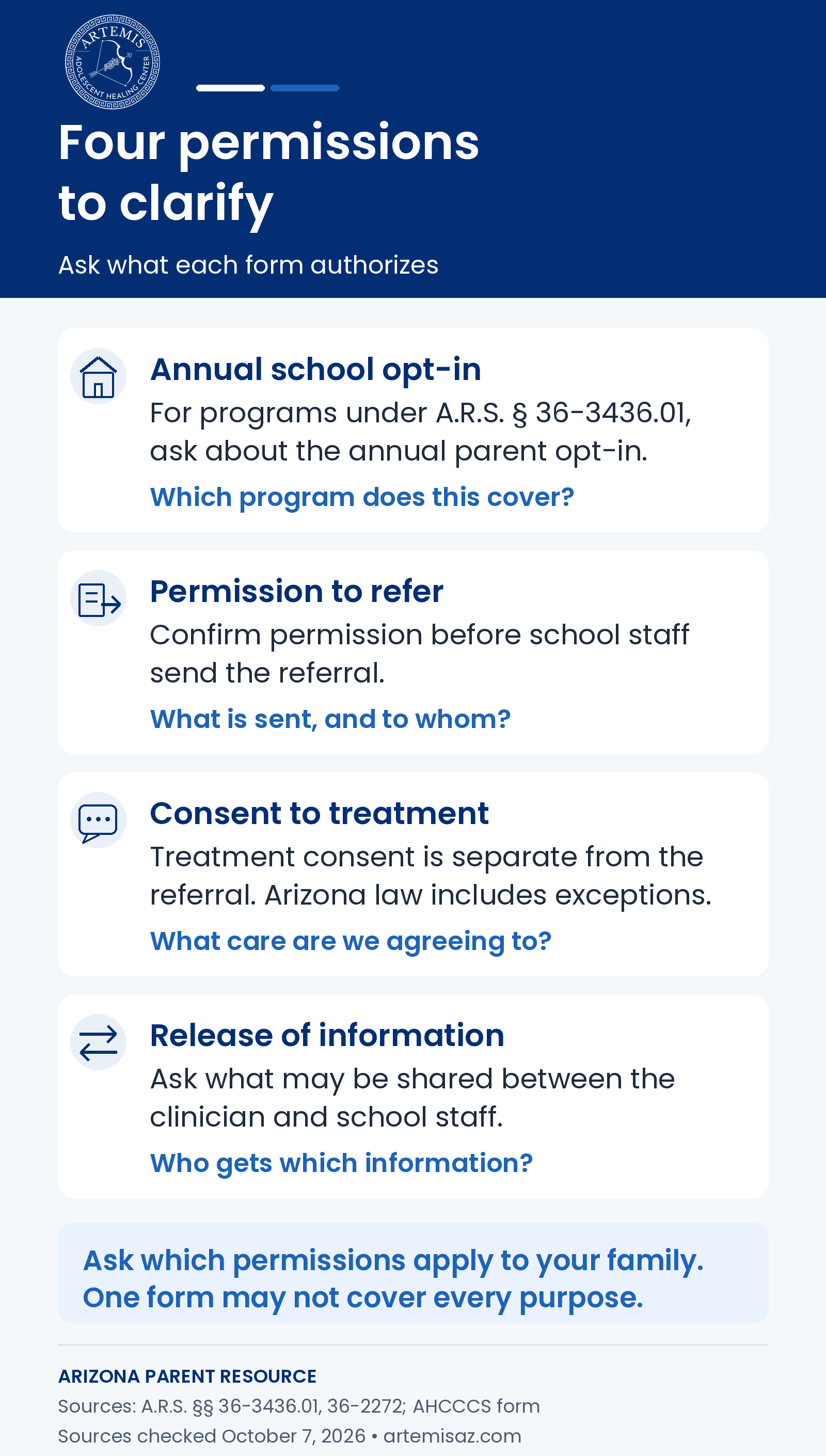
Text version: Consent and privacy
- Annual school opt-in: For programs under A.R.S. § 36-3436.01, ask about the annual parent opt-in. Which program does this cover?
- Permission to refer: Confirm permission before school staff send the referral. What is sent, and to whom?
- Consent to treatment: Treatment consent is separate from the referral. Arizona law includes exceptions. What care are we agreeing to?
- Release of information: Ask what may be shared between the clinician and school staff. Who gets which information?
Ask which permissions apply to your family. One form may not cover every purpose.
The annual-opt-in category refers to the school-based referral arrangements described by A.R.S. § 36-3436.01, including its fund/AHCCCS scope. This graphic does not assert that the statute applies to every school referral or that four separate forms are always required. Icons are categories, not a mandatory sequence.
Ask how treatment will be paid for
A school referral does not settle who will pay for treatment. AHCCCS says schools do not need to determine a student’s insurance status before referring to an AHCCCS-registered provider; funding can be addressed at intake. You can request the referral while those questions are being resolved. Ask the receiving provider to explain coverage and expected charges before routine services begin (AHCCCS, 2024).
If your teen has health insurance
For an AHCCCS member, call the member-services number on the insurance card to ask about access to behavioral health care (AHCCCS, 2024). With private insurance, ask the plan to identify adolescent providers and explain your benefits.
- Is this provider in our teen’s network?
- Does the service need a referral or prior authorization?
- What deductible, copayment, or other charges should we expect?
- Who can help us find another provider if this one cannot see our teen?
If your teen is uninsured or coverage is limited
Ask about grant-funded services as well as insurance eligibility. AHCCCS’s Mental Health Block Grant supports specified groups, including children with serious emotional disturbance. The grant has specific age, diagnosis, duration, and functioning criteria. A school concern alone does not establish eligibility. Ask a qualified provider to assess whether your teen meets the criteria and what funded services are available (AHCCCS, n.d.-a).
For substance use concerns, the Substance Use Prevention, Treatment and Recovery Services Block Grant may provide another route. It serves uninsured or underinsured people under eligibility and priority rules, with funding availability affecting access (AHCCCS, n.d.-b).
Ask which program is being considered, which services it can cover, and whether any costs remain. Do not assume that a school referral makes every service free.
Local starting points for Arizona families
These are routine access and funding contacts, separate from emergency help.
If your teen already has an AHCCCS plan, begin with the number on their card. For questions about other funding routes, the following published resources offer starting points (ADE & AHCCCS, 2026; Arizona Complete Health, n.d.; Mercy Care, 2026).
| Area | Published resource | What to ask |
|---|---|---|
| Tucson and Pima County | Arizona Complete Health grant-funded services 1-888-788-4408 | Which adolescent providers can assess eligibility for grant-funded mental health or substance use care? |
| Phoenix and Maricopa County | Mercy Care behavioral health in schools 1-800-564-5465 | How can our family connect with a school referral or ask about funding eligibility? |
Contacts were checked on the organizations’ public websites on October 6, 2026. They were not confirmed by telephone. Ask about current eligibility, appointment availability, location, and cost. A published contact does not mean an appointment is available.
Make sure the referral reaches a provider
AHCCCS publishes a School-Based Universal Referral Form in English and Spanish. The form is completed by school staff and includes contact information, the reason for referral, preferred language, and confirmation that the parent or guardian gave permission (AHCCCS, 2025).
Ask whether the school has sent the referral and to whom. Confirm the best telephone number, whether a voicemail is safe, and any interpreter needs. Request the intake office’s contact details so you can follow up directly.
If you do not hear back by the date you agreed on, contact the provider and school coordinator.
Ask whether the referral arrived, what is missing, and when intake can occur. If the provider cannot help, request another option. Tell a clinician about worsening symptoms rather than simply continuing to wait.
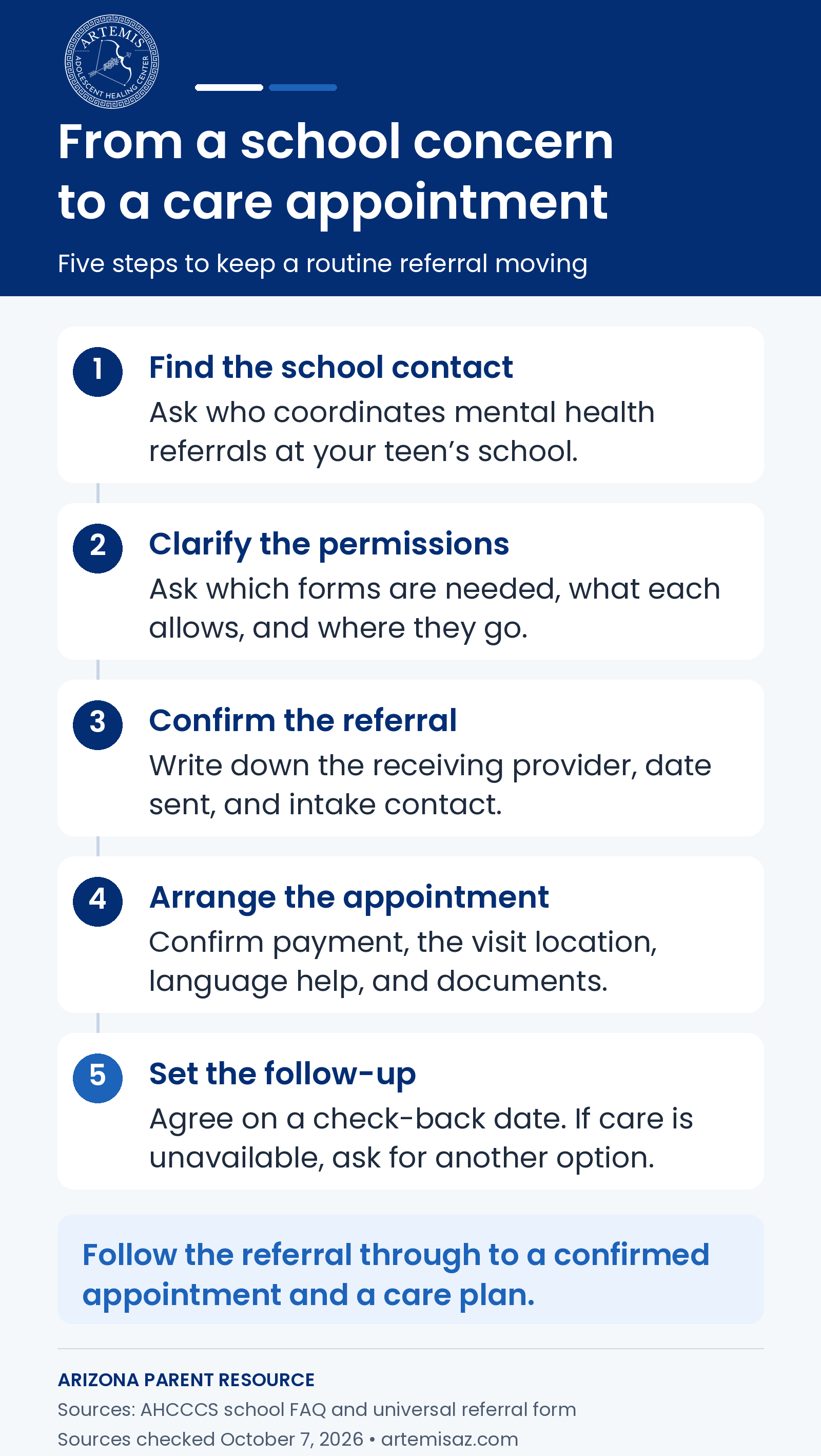
Text version: School referral path
- Find the school contact: Ask who coordinates mental health referrals at your teen’s school.
- Clarify the permissions: Ask which forms are needed, what each allows, and where they go.
- Confirm the referral: Write down the receiving provider, date sent, and intake contact.
- Arrange the appointment: Confirm payment, the visit location, language help, and documents.
- Set the follow-up: Agree on a check-back date. If care is unavailable, ask for another option.
Again, be sure to follow the referral through to a confirmed appointment and a care plan.
Keep a simple referral record
Use this checklist during calls. It is a planning tool, not an official referral or medical record.
| Step | What to write down |
|---|---|
| Choose a school contact | Name, role, telephone number, and best way to reach them. |
| Clarify consent | Forms needed, where they go, and date completed. |
| Confirm the referral | Receiving provider, date sent, and intake contact. |
| Check payment | Insurance or grant route, person checking it, and expected charges. |
| Arrange the visit | Appointment date, location, language needs, and documents requested. |
| Set the follow-up | Who will take the next step and the agreed date to check back. |
Keep these notes somewhere private. Share only what the school or clinician needs to coordinate care.
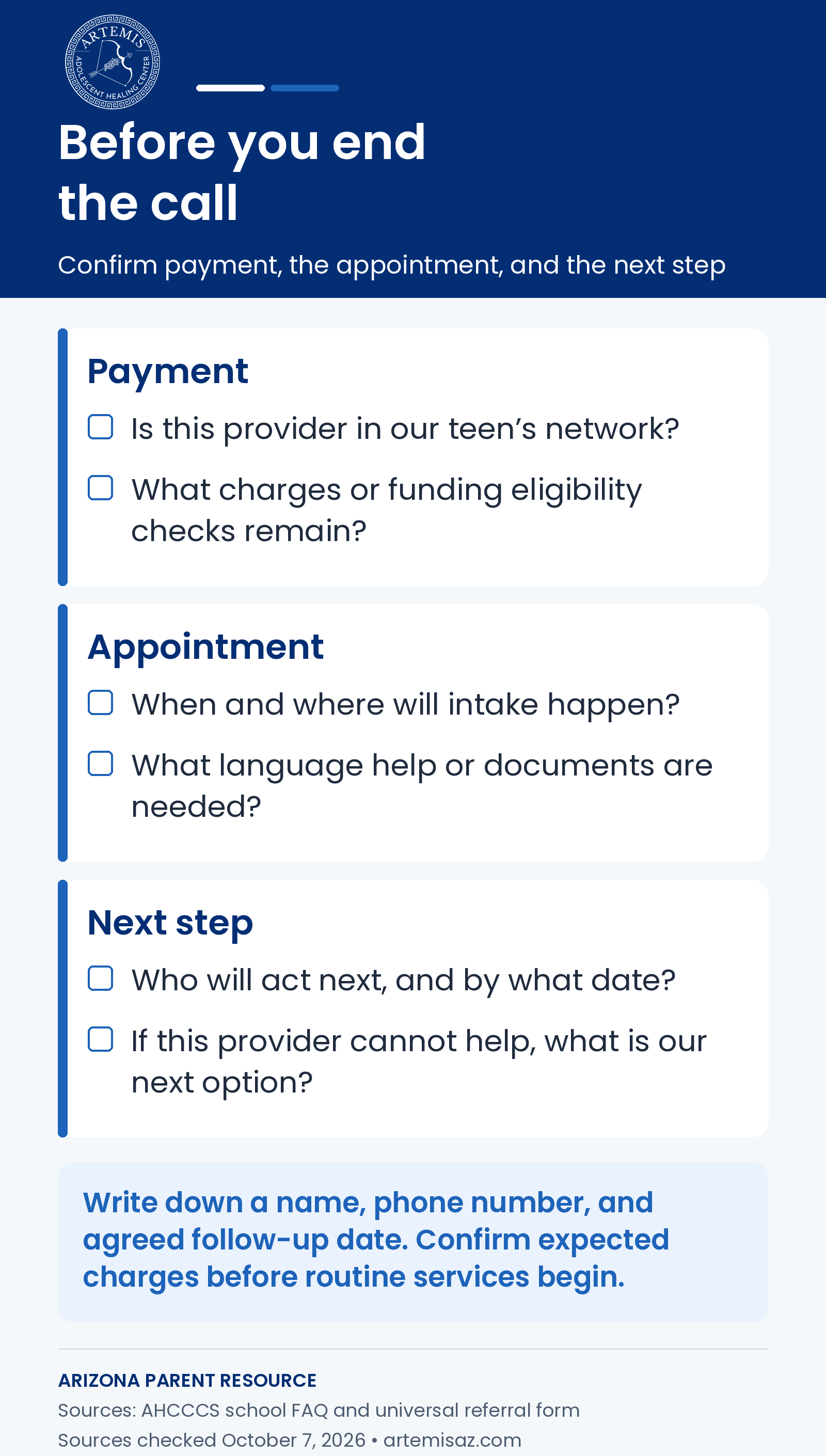
Text version: Referral call checklist
- Payment: Is this provider in our teen’s network? What charges or funding eligibility checks remain?
- Appointment: When and where will intake happen? What language help or documents are needed?
- Next step: Who will act next, and by what date? If this provider cannot help, what is our next option?
Write down a name, phone number, and agreed follow-up date. Confirm expected charges before routine services begin.
Include your teen in the conversation
Tell your teen what you are asking the school to do. Ask what would make a first appointment easier and what they want the clinician to understand.
You might also ask whether leaving class for an appointment worries them or whether they would prefer help outside school.
Bring those preferences to the school and provider. They can explain which options are available and how family participation and privacy will work.
When your teen needs more support
If support at school is not meeting your teen’s needs, ask a qualified clinician for an assessment and recommendations. Share what has been tried, what has changed, and what makes daily life difficult. The next step should reflect that assessment, rather than a school incident or a diagnosis alone.
At Artemis Adolescent Healing Center, we provide mental health treatment for teens ages 12–17.
Our team can discuss your teen’s needs and available treatment options. Contact us at (520) 614-8647 confidentially for a consultation. Ask about current eligibility, insurance, and any coordination needed with your teen’s school.
You can begin with a clear request today: identify the school contact, ask how a referral works, and agree on who will follow up. Then you can keep working toward a confirmed appointment and a care plan your family understands.
References
988 Suicide & Crisis Lifeline. (n.d.). Help someone else. Retrieved October 6, 2026, from https://988lifeline.org/help-someone-else/
Arizona Complete Health. (n.d.). Grant funded services. Retrieved October 6, 2026, from https://www.azcompletehealth.com/members/medicaid/resources/behavioral-health/grant-funded-services1.html
Arizona Department of Education, & Arizona Health Care Cost Containment System. (2026, February). School & behavioral health provider partnerships: A resource guide. https://www.azahcccs.gov/AHCCCS/Downloads/Initiatives/BehavioralHealthServices/SBH_ResourceGuide.pdf
Arizona Health Care Cost Containment System. (n.d.-a). Mental health block grant (MHBG). Retrieved October 6, 2026, from https://www.azahcccs.gov/Resources/Grants/MHBG/
Arizona Health Care Cost Containment System. (n.d.-b). Substance use prevention, treatment and recovery services block grant. Retrieved October 6, 2026, from https://www.azahcccs.gov/Resources/Grants/SABG/
Arizona Health Care Cost Containment System. (2024, July 16). Accessing behavioral health services in schools. Retrieved October 6, 2026, from https://www.azahcccs.gov/AHCCCS/Initiatives/BehavioralHealthServices/
Arizona Health Care Cost Containment System. (2025, March). School-based universal referral form. https://www.azahcccs.gov/AHCCCS/Downloads/Initiatives/BehavioralHealthServices/UniversalReferralForm.pdf
Arizona State Legislature. (n.d.-a). Arizona Revised Statutes § 36-2272: Consent of parent required for mental health screening or treatment of minors. Retrieved October 6, 2026, from https://www.azleg.gov/ars/36/02272.htm
Arizona State Legislature. (n.d.-b). Arizona Revised Statutes § 36-3436.01: School-based behavioral health services. Retrieved October 6, 2026, from https://www.azleg.gov/ars/36/03436-01.htm
Mercy Care. (2026, June 8). Behavioral health in schools. Retrieved October 6, 2026, from https://www.mercycareaz.org/behavioral-health-schools.html
Substance Abuse and Mental Health Services Administration. (2023). SAMHSA overdose prevention and response toolkit (Publication No. PEP23-03-00-001). https://www.cdc.gov/overdose-prevention/media/pdfs/2024/04/SAMHSA-overdose-prevention-response-toolkit.pdf